
# Online American Roulette in the UK: Odds and Play
::: hero-subtitle
See how the double-zero wheel changes the odds, how table bets and payouts work, and what casino labels can—and cannot—tell you.
:::
## American Roulette: The Extra Pocket That Changes the Odds
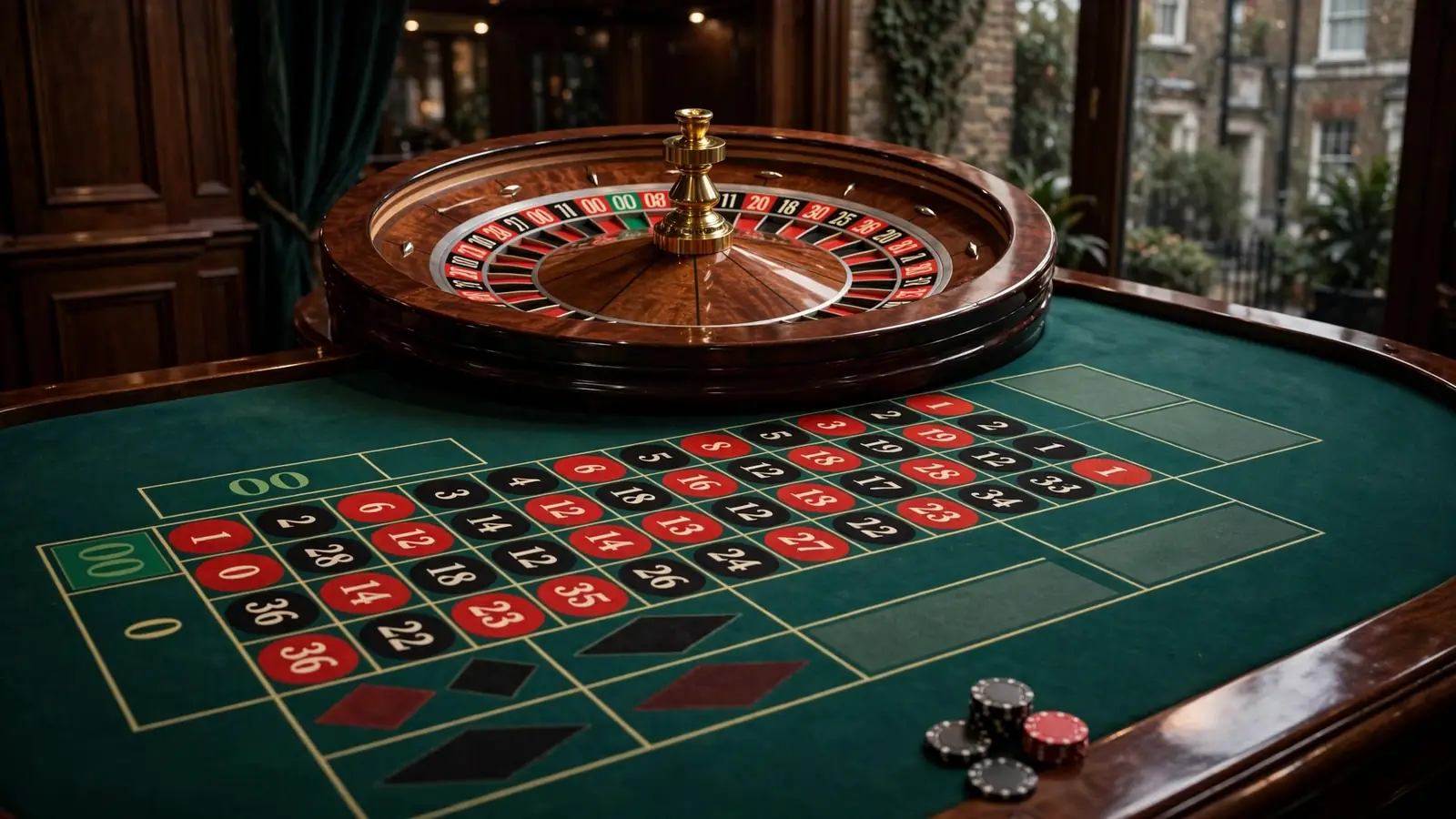
American Roulette differs from the European version in one small but consequential detail: it [includes a double-zero number](https://games.evolution.com/live-casino/live-roulette/), marked 00. That additional entry changes the odds attached to the game. The name can sound like a stylistic variation; it is not. The extra number is part of the outcome set, so it affects the chance of a selected number being the result.
The stated chance of winning in American Roulette is 1 in 38. In [European Roulette](/casino-games/online-casino-european-roulette-uk/), it is 1 in 37. The comparison is straightforward: American Roulette has one more possible result in the calculation, while a selection still has to match the number where the ball lands. The difference may look modest when written as a single step in the denominator. Over repeated play, it remains part of every spin’s underlying terms. A small change, built in.
This is the first distinction worth understanding when an online casino advertises American Roulette. The label identifies a format, but the double zero is what gives the label practical meaning. Without noticing it, a player could treat the American and European versions as interchangeable simply because both use familiar roulette language and similar-looking choices. The odds show otherwise.
::: top-operators
When choosing an online casino for American roulette in the UK, it helps to check practical details alongside the game itself. This list gives a concise reference point for payout speed.
### 1. Amunbet
**Payout speed:** 1-3 business days
Amunbet lists a payout speed of 1–3 business days.
—
### 2. Dieselwin
**Payout speed:** 1-3 business days
Dieselwin lists a payout speed of 1–3 business days.
—
### 3. Zombillion
**Payout speed:** 1-3 business days
Zombillion lists a payout speed of 1–3 business days.
—
### 4. BeOnBet
**Payout speed:** 1-3 business days
BeOnBet lists a payout speed of 1–3 business days.
—
### 5. NightLuck
**Payout speed:** 1-3 business days
NightLuck lists a payout speed of 1–3 business days.
—
### 6. Jetsetspins
**Payout speed:** 1-3 business days
Jetsetspins lists a payout speed of 1–3 business days.
—
### 7. x3bet
**Payout speed:** 1-3 business days
x3bet lists a payout speed of 1–3 business days.
—
### 8. Britsino
**Payout speed:** 1-3 business days
Britsino lists a payout speed of 1–3 business days.
—
### 9. SlotoSport
**Payout speed:** 1-3 business days
SlotoSport lists a payout speed of 1–3 business days.
—
### 10. Revery Play
**Payout speed:** 1-3 business days
Revery Play lists a payout speed of 1–3 business days.
:::
I have seen how descriptions can make a game variant sound like a matter of presentation. The more useful question is what changes in the game itself. Here, the answer is precise: American Roulette includes 00, and the stated odds are 1 in 38 rather than 1 in 37 for the European version. That is enough to distinguish the formats without relying on promotional descriptions.
The difference does not mean that a particular result is due to appear, or that previous outcomes make the next one more or less likely. It describes the odds for the format, not a forecast of an individual spin. A results history may show what has happened, but it does not remove the extra entry from the game or rewrite the stated odds. The double zero remains part of the calculation.
That matters when comparing online versions. A game’s title may include “American”, but the useful check is whether the displayed game is indeed the version with the double-zero entry. A name can identify the format; the game information confirms what is being offered. The distinction is not an obscure technicality. It is the reason the American version has different odds from the European one.
The extra pocket also explains why the difference should be considered before evaluating any other feature. Interface design, presentation and pace can affect how a session feels, but they do not change the stated comparison between 1 in 38 and 1 in 37. Nor does a familiar set of betting choices make the underlying formats identical. The additional 00 is the defining difference, and the odds follow from it.
For anyone looking at an online American Roulette casino in the UK, the sensible starting point is not a claim that one version is more exciting or more generous. It is the format’s basic structure and its stated odds. A casino may offer several roulette variants, but the word “roulette” alone does not tell the whole story. The American version carries the double zero; the European version has the lower stated denominator in the comparison.
$$LINKCARD live-casino-lightning-roulette-uk$$
I would keep that distinction separate from claims about strategy. Knowing the format helps identify the odds being described, but it does not provide a method for changing them. It is easy for a small difference to disappear beneath a polished screen or familiar terminology. In practice, the number that matters is the one included in the version being played.
So the extra pocket is not merely a visual detail or an alternate name on a game menu. It is the feature that separates American Roulette from the European comparison and accounts for the stated difference in winning odds. The numbers are 1 in 38 for American Roulette and 1 in 37 for European Roulette. No elaborate interpretation is required.
This explanation is for entertainment purposes only, not gambling advice.
## Choosing a Casino Without Mistaking a Label for a Guarantee
A casino can put “American Roulette” in a menu, a banner or a search filter. That establishes what it is advertising, not whether the operator is suitable or whether every part of its service is covered by the right authorisation. I learned to separate the game label from the business behind it. They answer different questions.
[For real-money play in Great Britain](/casino-games/online-casino-games-for-real-cash-uk/), the starting point is the operator’s UK Gambling Commission licence. Online gambling is legal only at licensed and regulated sites, and a [remote operator serving British customers](https://www.gamblingcommission.gov.uk/guidance/guidance-to-licensing-authorities/part-1-primary-legislation) must [hold the relevant licence](https://www.gamblingcommission.gov.uk/about-us/guide/what-we-regulate). Live dealer casinos are legal in the UK when they hold a UK Gambling Commission licence. A polished site, a familiar game title or the presence of a live table is not a substitute for that requirement.
### Identify the operator behind the site
The name on a website is not always enough to establish which company is providing the gambling service. The terms and conditions, privacy information and licensing page should identify the operating business. Those details should make it possible to connect the site’s legal operator with the licence information, rather than leaving the reader to infer it from a brand name.
$$LINKCARD online-casino-tournaments-uk$$
This is a basic but useful distinction: a brand is how a casino presents itself; the operator is the entity responsible for the service. If the site’s legal documents are difficult to locate, unclear about who runs the service, or inconsistent with its licensing information, the “licensed” wording on a promotional page does not settle the issue. It is the underlying operator that matters.
The UK Gambling Commission’s public information can be used to check whether the named business holds a current operating licence. The name should correspond clearly. A vague reference to regulation, without a verifiable operator identity, gives less assurance than a licence claim that can be matched to the business actually offering the account and games.
### Check what the licence covers
[A casino may offer several kinds](/casino-games/) of games through one account, but the presence of American Roulette does not itself prove that the service is authorised. The relevant question is whether the operator offering real-money gambling to UK customers holds the appropriate UK Gambling Commission licence. This applies whether the game is presented as a standard casino title or under a live-dealer heading.
I would treat any claim about a licence as a statement to verify, not as a badge that automatically validates every marketing claim around it. Licensing establishes a regulatory basis for the operator’s service; it does not mean that every game suits every player, that every promotion applies to roulette, or that the table conditions are identical across a site.
The distinction matters because casino pages often group together games, offers and account features in a single sales message. A licence claim answers a regulatory question. It does not answer the separate question of what the American Roulette table offers, or what conditions attach to a promotion. Labels are not guarantees.
::: dos-donts
#### Do
– Verify the operator’s UK Gambling Commission licence
– Identify the legal business entity in the terms and conditions
– Match the named business with public licence information
—
#### Don’t
– Treat a brand name as proof of authorisation
– Rely on a “licensed” badge on a promotional page
– Assume a game label is a guarantee of service quality
:::
### Read the game information separately
Once the operator’s identity and licence are clear, the game’s own information still deserves attention. The American Roulette rules and table information should be available before play, including the terms that explain how the game works and how wagers are settled. The felt and game interface provide the practical context; promotional copy is not a replacement for the rules.
This does not require turning a casino comparison into a hunt for a supposedly perfect table. It means keeping distinct checks distinct: operator authorisation on one side, game rules and table conditions on the other. If the information is missing or hard to interpret, that is a reason to pause rather than assume that the title alone fills in the gaps.
Inside bets and outside bets belong to the game’s betting choices, not to the operator’s licence status. A casino may advertise the game while the specific table information explains which options are offered there. The menu label cannot establish those details. Review the table rules and paytable before playing.
### Treat “best” as a question of fit
There is no single operator label that proves a casino is the best choice for American Roulette. A useful assessment begins with verifiable points: who operates the site, whether that business holds a current UK Gambling Commission licence, and whether the game’s rules and conditions are clearly presented. Those checks are more meaningful than a broad claim of quality with no explanation behind it.
I have seen how “best” works in casino copy: it can sound like a conclusion while concealing the criteria. One comparison may focus on the size of a welcome offer; another may use game count or presentation. Neither phrase, by itself, explains whether the operator is properly licensed or whether the roulette terms are clear. The word does not do the checking.
A sensible review also keeps promotional claims in their proper place. A casino can make American Roulette available without every bonus applying to it, and game availability does not tell the reader whether a particular offer has useful terms. Those are separate decisions, best assessed from the relevant offer conditions rather than assumed from the game listing.
$$LINKCARD online-bingo-uk$$
The practical test is not whether a site calls itself a leading American Roulette casino. It is whether its legal operator can be identified, its UK licence can be verified, and its game information is accessible before play. No label replaces those checks. This article is for entertainment purposes only, not gambling advice.
## Live American Roulette: A Physical Wheel, a Slower Game
Live dealer American Roulette is built around a real wheel rather than a digital animation. A human dealer spins it in a studio, while the game is streamed to the screen in real time. Bets are entered through an on-screen interface; the stream shows the physical game as it unfolds.
That distinction matters because the software is not generating each result with a Random Number Generator. In computerized roulette, an RNG determines the outcome. In a live game, the ball and wheel are physical, and the result is shown through the broadcast. The two formats can look similar on a screen, but the process behind the result is different.
From the operator’s side, live play also has a different rhythm. The dealer has to run the game, and players need time to make their selections through the interface. The game therefore moves more slowly than a digital version, where software can progress from one round to another without a dealer’s actions. There is less of the rapid, repeated pace that can make a computerized game feel continuous.
That slower rhythm is not automatically an advantage or a drawback. It changes the experience. A live table gives the game a visible human presence and a physical setting; a digital version is more immediate. The trade-off is time: the live format has pauses that belong to the process, not necessarily to a technical fault.
Connection quality is part of the practical decision. A stable internet connection is needed to receive the stream and use the betting interface reliably. If the picture freezes or the connection drops, the experience can become difficult to follow. That is a different concern from the wheel itself: the physical spin may continue in the studio while the player’s screen is delayed or interrupted.
$$LINKCARD online-casino-without-id-uk$$
The interface is the bridge between the broadcast and participation. It lets players make selections on screen while the dealer handles the physical game. This means the format combines a real-time video stream with software controls. It is not the same as sitting at a physical table, and the stream does not remove the need to understand the interface or its timing.
Live tables also tend to have higher minimum bets than digital games. That difference can make the format less suitable for someone who wants to try a game at a very small stake. The slower pace and the minimum required to join are separate features: one affects how quickly rounds proceed, the other affects the cost of entering a round.
I have found it useful to judge the format by what it actually changes: a human dealer, a physical wheel, a streamed game and a slower cadence. It does not change the basic nature of roulette. The attraction is the visible process; the compromise is less speed and a greater reliance on a steady connection.
This section is for entertainment purposes only and is not gambling advice.
## How Bets Work—and What the Payout Edge Leaves Behind
Roulette has a simple win condition: a ball comes to rest on a number, and a bet wins when it covers that number. The rest is a question of what the wager was placed on and how the game pays it. That distinction matters because a larger advertised payout is not the same thing as a better long-term return.
A straight-up bet selects one number. If the ball lands there, the selection matches; if it lands elsewhere, the stake is lost. Other bets cover broader outcomes rather than a single number. Their payouts differ accordingly: a narrower selection can bring a larger return when it wins, while a broader one pays less for a hit. The trade-off is built into the bet, not a special feature of a particular casino.
::: info-callout
In American Roulette, the stated house edge is 2.9% on straight-up bets and 2.7% on other bets.
:::
When I compare bets, I separate the size of a winning payout from the house edge. The first describes what a successful wager returns under the game’s paytable. The second describes the built-in disadvantage across play over time. In roulette, the stated house edge is 2.9% on straight-up bets and 2.7% on other bets. The difference is small, but it is a real distinction between these categories.
That does not mean choosing a broader bet makes a spin safer in any reliable sense, or that a straight-up selection is a route to a larger overall return. Each spin is settled on its own result. A bet that covers more outcomes can win more often than a narrowly targeted one, but its payout is correspondingly lower; the house edge remains the useful comparison for the cost embedded in the rules.
“Big payout” is a sales-friendly phrase. What sits behind it is a low-frequency hit paired with a larger return when it occurs. A modest-looking payout can still be attached to a bet that wins more often. Neither description alone tells the whole story. I look at the wager’s coverage, its stated payout and the edge together, rather than treating one attractive figure as proof that a bet is favourable.
For anyone learning how to play American Roulette, the practical sequence is straightforward: identify what the wager covers, wait for the result, then compare the winning number with that selection. Online, the same win condition applies whether the bet is made through an on-screen interface or at a streamed table. The interface may make it easy to add or repeat wagers; it does not change what counts as a win.
Before placing a real-money bet, the table rules and paytable are the relevant documents. They show how a selection is settled and what a winning wager returns. I have seen players focus on the headline payout and skip the underlying terms. That is where the comparison goes wrong. A payout is conditional; the edge is part of every wager’s arithmetic.
$$LINKCARD french-roulette-online-casino-uk$$
American Roulette payouts should therefore be read as outcomes attached to specific bets, not as a promise of profit. The figures describe the game’s pricing, not a prediction of what a session will produce. This content is for entertainment purposes only, not gambling advice.
## Reading the American Roulette Table Layout
An American Roulette casino table is easiest to read as a map of betting choices. The numbered area sits at its centre, with other marked spaces around it. The felt is not decoration: each boundary shows where a chip can be placed and which part of the game that position refers to.
The detail that distinguishes the American layout is the additional **00** entry. It appears alongside **0** as a separate choice on the table, rather than being folded into the numbered grid. That extra marking can be easy to overlook when a screen view is reduced or the table is shown at an angle. I have seen players focus on the familiar numbered field and miss that the American version has another marked space.
The grid is the part most people recognise first. Each number has its own space, while the surrounding areas group numbers into broader selections. Those grouped spaces make the table legible at a glance: the layout offers a way to mark an individual number or a wider category without changing the underlying result of a spin. The table communicates the available choices; it does not change them.
On a live dealer screen, the table may be presented from the dealer’s perspective, from above, or as a flattened digital image. The viewing angle can make the numbered grid look less familiar, but the markings remain the useful guide. A chip placed on a line or shared boundary can represent a different selection from one placed squarely inside a single space. The position matters.
That is why a quick scan of the felt is more useful than relying on the label “American Roulette” alone. A title identifies the game format, but the table itself shows how its choices are laid out. The 00 marking is the clearest visual check. If it is not visible, the screen may be cropped, the layout may be temporarily obscured, or the game may not be the format the label suggests. Check the displayed table before play.
$$LINKCARD mines-casino-game-uk$$
In my experience, presentation is where small misunderstandings begin. Interfaces compress information to fit a screen, and promotional labels tend to say less than the felt does. A clearly shown American Roulette table should make both zero entries visible, including the separate double-zero space. No mystery there.
The layout also helps distinguish the numbered field from the surrounding selections without requiring a player to memorise the whole table. Each marked area has a defined place, and the chip position is read against those printed boundaries. It is a practical interface, not an odds guide. The felt shows where choices are made; understanding what a chosen position means is a separate matter.
When the whole table is visible, the central grid and the additional 00 marking tell the essential story of its design. When part of it is hidden behind menus or overlays, the game name alone is not a substitute for seeing the actual layout. A label can be brief. The felt is specific.
## The American Roulette Wheel: Zero and Double Zero
The defining feature of an American Roulette wheel is easy to spot: it has two green pockets, marked 0 and 00. A European Roulette wheel has one green pocket, marked 0. The colour sets these entries apart from the numbered pockets around them, while the double-zero marking distinguishes the American version from a single-zero wheel.
That is the important visual check when identifying the wheel itself. The 00 is not another way of writing the ordinary zero; it is a separate pocket. On an American wheel, both entries are present. On a European wheel, only 0 appears. The distinction is small in appearance, but it identifies a different wheel format.
$$LINKCARD live-dream-catcher-casino-uk$$
I have found it useful to separate that check from the wording used around a game. A casino may label a table “American Roulette”, but the wheel is the clearest physical reference point: look for both green pockets, not just a product name. If the wheel is shown on screen, the markings can be checked directly. If the wheel is not clearly visible, the label alone tells less.
The double zero can also be overlooked because it is easy to read the two markings as a single symbol or as a decorative variation. They are two distinct numbered pockets. Green is the shared visual cue; the number printed on each pocket makes the difference clear. A wheel with a green 0 but no green 00 is not the American double-zero wheel described here.
This is separate from the felt. The table has its own printed betting areas and number arrangement, and a double-zero entry may appear there as well. But the wheel is not identified by the layout of the felt: it is identified by its own two green pockets. Keeping those objects distinct helps avoid mistaking a table image or game label for a direct view of the wheel.
The American and European formats therefore differ at a glance, even before considering how a game is presented. One has a pair of green pockets, 0 and 00; the other has a single green 0. That is the whole identifying feature, not a promise about the casino, dealer or conditions attached to a particular game. “American” describes the wheel format here. It does not by itself establish what rules a specific table uses.
When checking a displayed wheel, the useful detail is not its animation or camera angle but whether both green markings can be seen. A cropped image may hide one pocket, so an incomplete view cannot confirm the format. A clear view can. Two green entries: American. One green entry: European. The distinction is simple; the wording around it sometimes is not.
## Real-Money Play: Stakes, Limits and a Set Budget
Real-money American Roulette turns each chip into an actual debit from the account balance, so the useful decision comes before the first spin: how much is available for the session, and where play stops. A budget is a boundary, not a target to spend. Once it is reached, changing the stake to recover a loss defeats its purpose.
$$LINKCARD crazy-time-live-casino-game-show-uk$$
The minimum stake can shape the experience as much as the wheel does. A specialist review reports that some live roulette and baccarat tables have opened at 20p; that is a reported table setting, not a promise that every American Roulette table will offer it. Blackjack starting limits were described as higher in the same review. Table conditions can differ, so the displayed limits matter more than a general description.
I treat the minimum as a practical filter. If the smallest permitted bet is too large for the set budget, that table does not fit the session. A lower minimum does not make the game safer or improve its terms; it simply allows smaller individual bets. The maximum matters too, but a high ceiling is not a reason to increase stakes. Limits define what the table permits, not what a bankroll can comfortably absorb.
American Roulette betting options can make stake control more deliberate: a player can choose how much to place and how widely to spread it. That choice does not turn a particular pattern into a way of controlling the result. Nor does raising a stake after a loss repair the balance; it puts more money at risk. Staking systems may look orderly on paper, but they cannot remove the game’s house edge.
I would set a total budget first, then decide on a stake that leaves room to stop without trying to win back what has gone. The stop point should remain fixed whether the balance rises or falls. This is basic discipline, not a method for making roulette profitable.
Before confirming a real-money bet, the amount on screen deserves a final check. A misplaced chip or an unexpectedly large stake can matter more when the table minimum is already close to the planned limit. Small check. No chasing.
$$LINKCARD casino-dice-game-uk$$
This section is for entertainment purposes only, not gambling advice. Real-money play involves financial risk; a budget should be treated as a firm limit, not something to extend during a session.
## What a Casino’s Roulette Offer Says—and What It Doesn’t
When a casino lists American Roulette, that tells me the game is available somewhere in its catalogue. It does not tell me that every table has the same rules, limits or format, or that the game is included in a particular promotion. Availability is one thing; the terms attached to a session are another.
The distinction matters most when a welcome offer is involved. A specialist review describes UK welcome offers as commonly [built around free spins on slots](/casino-games/best-online-slots-payout-percentage/), which cannot be used at live tables. That is a description of an offer pattern, not a promise about every operator’s current terms. A casino may carry American Roulette and still provide no welcome bonus that applies to it.
Bonus wagering rules can narrow the offer further. Live games may contribute only a small share towards wagering requirements; a stated weighting can be as low as 10%. That means roulette play may make limited progress against the requirement, even when the game is technically eligible. “Eligible” is not the same as equally weighted.
I learned to separate the game catalogue from the promotional wording. The catalogue answers whether American Roulette can be played. The offer terms determine whether a bonus applies, which games qualify and how their contribution is calculated. The headline alone does not settle any of that.
Before opting in, the relevant terms are the wagering requirement, game weighting and any maximum bet limit. Those conditions can change the practical value of an offer more than the presence of a roulette table does. A free-spins promotion may have no use at a live table; a bonus that accepts roulette may still assign it a restricted contribution.
The commercial distinction is plain. A game listing attracts interest; bonus rules define the boundaries of the promotion. I treat them as separate claims, not one package. This is entertainment content, not gambling advice.
::: warning-callout
**Attention**
Welcome offers often focus on free spins for slots and may not apply to live American Roulette tables; always check the wagering requirements and game weighting.
:::
## The American Roulette Game: Physical Deal or RNG
“American Roulette” describes the version of the game, not necessarily how each result is produced. An online American roulette casino game may be presented as live dealer roulette, with a person spinning a physical wheel, or as computerized roulette, where a Random Number Generator (RNG) produces the result. The distinction is about the game’s format; the word “American” alone does not tell how a round is generated.
In a live game, the dealer spins the wheel and the ball lands in a pocket. The action is captured and streamed from the studio, so the result comes from a physical event rather than a computer-generated spin. Computerized roulette replaces that wheel-and-ball process with an RNG. The screen still presents a roulette round, but the outcome is generated by software.
I find it useful to separate the game’s rules from its presentation. A polished video of a wheel does not, by itself, establish that the game is live; the relevant distinction is whether a dealer is spinning a physical wheel or software is generating the outcome. Conversely, an online game is not automatically RNG-based: live dealer roulette is also played online, with bets placed through an on-screen interface.
That difference can matter to the feel of a session. Live play shows the physical wheel in motion, while computerized play presents the result without a dealer operating a wheel. Neither format changes what “American” identifies: it refers to the roulette version, not the method used to generate each result. Separate questions about a particular table’s rules or the operator offering it are not answered by the format label.
No magic in the label. A live broadcast and a computer-generated game are different ways to run roulette, and the interface should make clear which one is being offered. For anyone comparing an online American roulette casino game, identifying the format is the first practical distinction; the word “live” or an RNG description tells more than the game name alone.
## How Many Pockets Does an American Roulette Wheel Have?
An American roulette wheel has **38 pockets**: the numbered entries from 1 to 36, plus a green 0 and a green 00. That second zero is the detail that brings the total to 38. On a European wheel, there is no 00, leaving 37 pockets.
The count matters because it changes the chance of a single-number selection winning. If a bet covers one number, the ball must land in that specific pocket. In American Roulette, the chance is **1 in 38**; on a European wheel, it is **1 in 37**. The extra pocket is not an additional winning number for a bet placed on a different number. It is another possible result the selection has to contend with.
I have found that “American” can sound like a minor variation in a game description. Here, it identifies a different set of outcomes. The wheel’s pocket count gives a direct way to distinguish the format, while the 00 explains why its single-number odds are not the same as the European version.
The count does not mean every roulette bet has a 1-in-38 chance of winning. That figure applies to selecting one number and needing the ball to land there. Other selections cover different numbers, so their chances are not described by that single-number comparison.
One extra pocket. A real difference.
When checking a game description, the useful detail is whether the wheel includes both 0 and 00—not merely whether the title says “American Roulette”. The same double-zero entry appears in the game’s number set, so it is part of the possible outcomes rather than a decorative label. A wheel with 38 pockets is therefore the straightforward answer to how many pockets are on an American roulette wheel, and the 1-in-38 figure explains the connection between that count and a single-number win.
::: faq
## How do you play live roulette?
Place bets using the on-screen interface while a human dealer spins a physical roulette wheel. You win when the ball lands on a number you selected.
—
## What types of roulette can you play with a live dealer?
Live roulette variants include American, European and French Roulette. American Roulette has both 0 and 00, while European Roulette has a single 0; French Roulette offers a rule where an even-money bet loses only half on zero.
—
## What is the difference between European and American Roulette?
American Roulette has an extra pocket, 00, giving it 38 possible results; European Roulette has 37, with a single zero. The stated odds of winning are 1 in 38 for American Roulette and 1 in 37 for European Roulette.
—
## How do you choose a live dealer casino?
For real-money play in Great Britain, choose an operator with a UK Gambling Commission licence. Check that the operator named in the site’s terms and legal information matches the business listed in the Commission’s public licence information.
:::
[Responsible Gambling](/responsible-gambling/)