
# UK Casinos That Accept E-Wallets: Deposits and Payouts
::: hero-subtitle
Wallet availability can vary by cashier, and deposit support does not necessarily mean withdrawals use the same route.
:::
## How e-wallets fit into UK casino payments
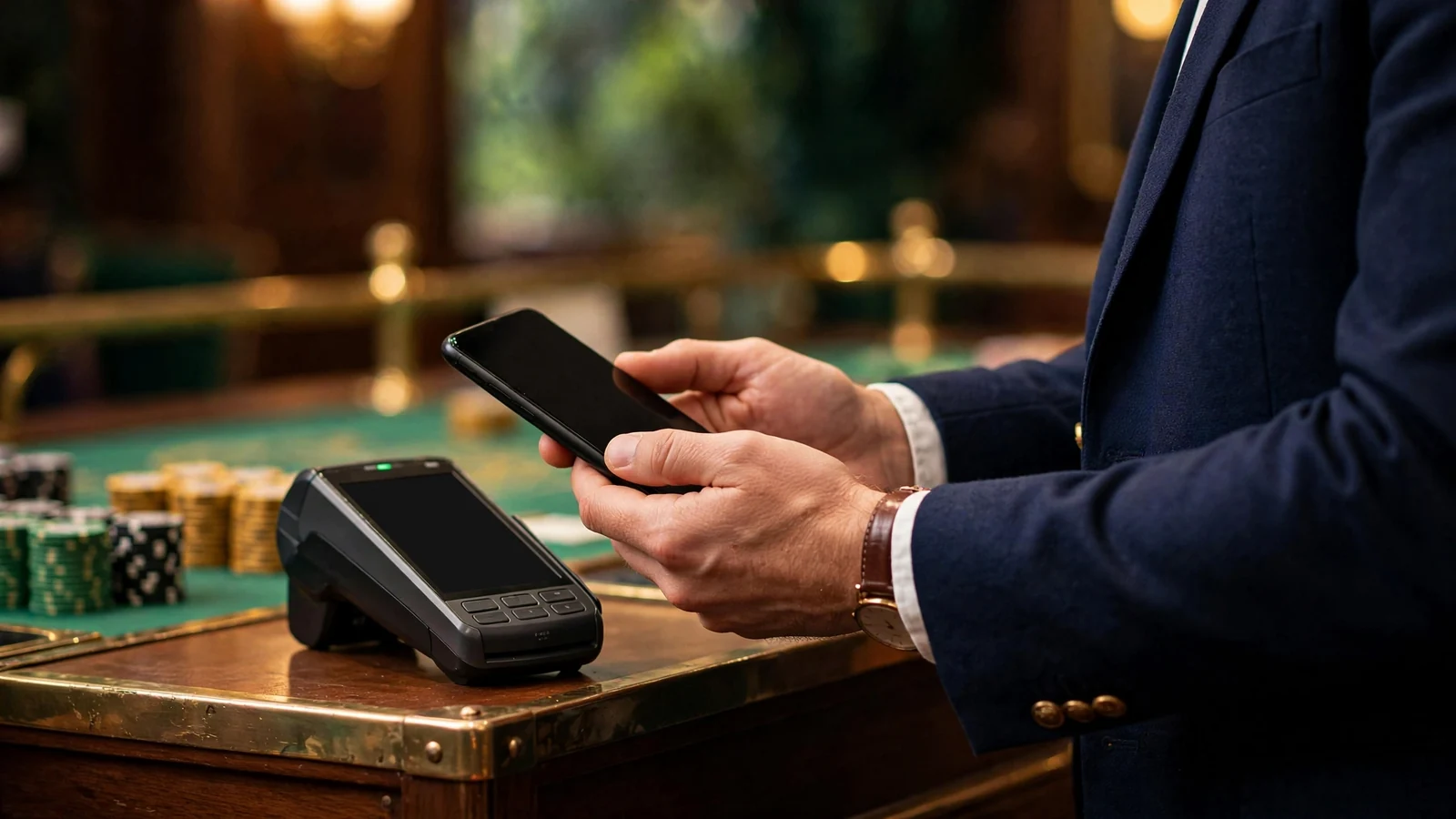
An e-wallet sits between a casino account and a customer’s underlying payment arrangements. Rather than entering card details into a casino cashier for each transaction, a customer selects a wallet and authorises the payment through that service. The casino receives the transaction through its payment connection; the wallet handles the customer-facing authorisation. That extra layer is the point: it can make payment handling feel separate from the casino account, though it does not make every wallet available everywhere.
The main alternatives are debit cards and bank-based routes. UK casinos commonly accept debit cards, including Visa and Mastercard. These are familiar options, but a card’s logo alone does not establish that it will work at a particular cashier: the operator’s current payment choices determine what can be used there. Bank transfers and open banking provide another route, with a connection to a bank account rather than a stored wallet balance. A specialist casino review describes these bank-based methods as capable of supporting instant deposits and fast withdrawals at many sites; that is a reported capability, not a promise that every casino offers it or processes each transaction at the same pace.
::: top-operators
Choosing a UK casino that accepts e-wallets involves checking the payment options and how quickly withdrawals are processed. This list provides a reference point for considering payout speed.
### 1. Amunbet
**Payout speed:** 1-3 business days
Amunbet lists a payout speed of 1–3 business days.
—
### 2. Dieselwin
**Payout speed:** 1-3 business days
Dieselwin lists a payout speed of 1–3 business days.
—
### 3. Zombillion
**Payout speed:** 1-3 business days
Zombillion lists a payout speed of 1–3 business days.
—
### 4. BeOnBet
**Payout speed:** 1-3 business days
BeOnBet lists a payout speed of 1–3 business days.
—
### 5. NightLuck
**Payout speed:** 1-3 business days
NightLuck lists a payout speed of 1–3 business days.
—
### 6. Jetsetspins
**Payout speed:** 1-3 business days
Jetsetspins lists a payout speed of 1–3 business days.
—
### 7. x3bet
**Payout speed:** 1-3 business days
x3bet lists a payout speed of 1–3 business days.
—
### 8. Britsino
**Payout speed:** 1-3 business days
Britsino lists a payout speed of 1–3 business days.
—
### 9. SlotoSport
**Payout speed:** 1-3 business days
SlotoSport lists a payout speed of 1–3 business days.
—
### 10. Revery Play
**Payout speed:** 1-3 business days
Revery Play lists a payout speed of 1–3 business days.
:::
E-wallets occupy a middle ground. They are not simply another card brand, and they are not the same as a direct bank transfer. A wallet account may hold funds or connect to other funding sources, while the payment at the casino is authorised through the wallet service. PayPal, [Skrill and Neteller](/payment-methods/casinos-that-accept-neteller-uk/) are familiar names in this category, although their presence at one casino says little about their availability at another. In practice, the useful question is not whether a payment brand exists in the market, but whether it appears as an active option in that casino’s cashier.
This is why “accepts e-wallets” can be an imprecise description. It may mean that a casino supports one wallet but not another, or that a method is available only under particular account or transaction conditions. A cashier is a set of connections selected and maintained by the operator, not a universal menu shared across the industry. Payment providers also have their own operating arrangements. The result is variation between sites, even when the same broad types of payment appear across the market.
I have found that the category label can conceal the practical distinction. A site may advertise cards, wallets and bank payments together, giving the impression that all are interchangeable. They are not. Each route has a different authorisation process and depends on the specific options displayed for that account. A wallet can be convenient for someone who already uses it; a debit card may be more straightforward for someone who prefers paying directly from a bank account. Neither description settles which method a casino will accept.
$$LINKCARD casinos-that-accept-giropay-uk$$
There is also a difference between a payment method being known and it being supported for a particular transaction. A casino may name a wallet in general payment information, while the cashier presents a narrower selection at the point of use. Payment availability can also change as operators update their arrangements. For that reason, broad claims about “online casinos with e-wallets” are less useful than the live cashier on the site being considered. The detail is operational, not cosmetic.
The same caution applies to claims about speed. A specialist casino review characterises PayPal as popular for convenience and speed, but that description should not be read as a guaranteed experience at every operator. The wallet’s own processing is only one part of the journey; the casino’s payment setup and handling also matter. A method can feel quick at the authorisation stage without making the entire casino transaction equally quick. Distinctions between deposits and withdrawals need separate attention, rather than being folded into one general claim about a wallet.
For a broad comparison, it helps to think in terms of [payment routes](/payment-methods/) rather than a league table of brands. Debit cards offer a familiar direct route; bank-based methods connect payment activity to a bank; e-wallets add a separate account or service into the chain. Which route fits depends on what the casino makes available and how the customer prefers to authorise payments. There is no single method that can be assumed to appear across every UK casino.
::: info-callout
Payment availability is operational, not cosmetic; broad claims about e-wallet support are less reliable than the live cashier on the specific site being considered.
:::
The practical picture is therefore mixed: e-wallets are one part of a wider payment system, alongside debit cards and bank-based services. Their appeal is not evidence of universal acceptance, and a payment brand’s reputation does not replace checking the operator’s own cashier. A method is relevant only when it is actually offered for the intended transaction. That is the working distinction.
## When an e-wallet payment works against a bonus
An e-wallet can make a deposit feel straightforward and still be the wrong choice for a promotion. The payment succeeds; the bonus does not attach. From the cashier’s side, those are separate checks. A method being available for deposits does not, by itself, mean that deposits made with it qualify for every offer.
Skrill and Neteller illustrate the distinction. A specialist casino review reports that some sites accept these wallets while excluding them from promotions. That is a site-specific condition, not a rule that can safely be assumed across the market. The relevant point is the wording attached to the particular offer: payment acceptance and bonus eligibility may sit in different parts of the terms.
This is where the word “welcome” can mislead. It describes the promotion’s intended audience, not necessarily every route by which a qualifying deposit can be made. An offer may be open to a new customer but still restrict eligible payment methods. If a wallet is listed among the exclusions, using it can leave the account without the advertised bonus even though the deposit itself has gone through normally.
$$LINKCARD casinos-that-accept-ideal-uk$$
I have seen this treated as a cashier problem when it is really a terms problem. The transaction record says funds arrived. The promotion rules decide whether those funds count. A support conversation after the deposit may clarify how the operator applied its terms, but it cannot turn an excluded method into an eligible one. The order of checks matters.
The practical comparison is therefore not simply “wallet or no wallet”. It is the value of the promotion against the value of using the chosen payment route. Someone who values the wallet’s convenience may reasonably prefer it and leave the offer aside. Someone focused on a particular promotion needs to establish whether that method qualifies before depositing. Neither choice is inherently better; the mistake is treating the bonus as automatic.
The same distinction matters when several offers appear in an account. A promotion can have its own conditions, separate from the general bonus policy or the cashier’s payment list. Terms may identify eligible methods, excluded methods, or other requirements for a qualifying deposit. A general statement that a casino accepts e-wallets cannot answer those offer-level questions.
“Claim bonus” is a button, not proof of eligibility. Where the promotion requires an eligible deposit, selecting the offer and completing a payment through an excluded wallet may not produce the expected result. The terms and any confirmation shown during the process are more informative than the button label. If the conditions are unclear, it is better to resolve that uncertainty before the transaction than to rely on an assumption afterwards.
::: dos-donts
#### Do
– Read the offer conditions alongside payment information
– Check for specific wording about excluded wallets
– Resolve uncertainties before making a transaction
—
#### Don’t
– Treat the “Claim bonus” button as proof of eligibility
– Assume a welcome bonus is automatic for all accepted methods
– Rely on attractive headlines over clear confirmation
:::
There is also a difference between a promotion being unavailable and a payment being rejected. An excluded wallet may still be usable for ordinary deposits; it is the promotional benefit that is affected. That distinction can be easy to miss when the cashier presents the wallet as an accepted route and the offer is displayed elsewhere on the site. The interface may look like one joined process. Operationally, it need not be.
I would read the offer conditions alongside the payment information, rather than treating either page as a complete answer. Look for the method name, any wording about excluded wallets, and the conditions that define a qualifying deposit. If the site presents a promotion before the payment step, that does not necessarily settle whether the selected method is covered. A clear confirmation is more useful than an attractive headline.
For anyone comparing casino sites that accept e-wallet deposits, bonus eligibility is a separate measure from payment availability. A site may suit a player who wants to use a wallet without a promotion, while another may be preferable when a particular offer is the priority. The useful comparison is the actual combination of method and offer, not a broad label such as “best”.
No assumption travels well. Skrill or Neteller may be accepted at one site and excluded from a promotion there; another site’s terms may treat the same wallet differently. The offer governs. Read that condition before the deposit, and judge the wallet by what it can do in the specific transaction—not by the fact that its name appears in the cashier.
$$LINKCARD casinos-that-accept-revolut-uk$$
## Deposits are not the same as withdrawals
A payment method shown in a casino cashier describes a route into the account; it does not, by itself, confirm how winnings will be paid out. That distinction matters with e-wallet deposits. The deposit may be accepted immediately, while a withdrawal follows a separate process involving the casino’s approval and the rules governing where funds can be returned.
UK anti-money laundering rules generally require a payout to go back to the original payment source. This is often called a closed-loop approach: money is returned along the route from which it came, rather than sent wherever is most convenient at the point of withdrawal. If an e-wallet was used to fund the account, the casino may therefore direct the payout to that wallet, subject to its payment procedures.
The wording is about the source of funds, not merely the name of a payment brand. A wallet deposit and a card deposit are different routes, even if both are displayed in the same cashier. Nor does seeing a method beside the deposit option prove that it is available for withdrawals. The route can be specific to the transaction and the account.
This is where the idea of “instant” can mislead. A specialist review describes card deposits as potentially instant while a card payout may take several business days. Those are different stages, not contradictory estimates: the deposit is an incoming authorisation, while a withdrawal must pass through the casino’s approval process and then the payment route. Fast in. Slower out.
::: warning-callout
**Attention:** A payment method that is accepted for immediate deposits may follow a separate, slower process for withdrawals involving casino approval.
:::
In my experience, payment descriptions can make these stages look like one service when they are not. A deposit confirmation says that funds have reached the gambling account; it says nothing about when a later withdrawal will be approved or delivered. The cashier’s displayed method, the withdrawal terms and the account’s status all shape what happens next.
A specialist review also notes that withdrawal processing includes internal casino approval and can take longer for a first withdrawal while verification is completed. That distinction is easy to miss when a deposit arrives quickly. The casino has to process the outgoing request, and an account awaiting checks may not move through the same path as one already verified. Approval and delivery are separate parts of the wait.
For e-wallet users, the practical point is to treat the deposit route as part of the later payout plan, not as a one-way convenience. A wallet that works for adding funds may have its own withdrawal conditions, and the casino’s closed-loop rules may determine whether it can be used to return them. The cashier’s deposit screen is only one part of the picture.
The same principle applies beyond wallets. A card payment can be authorised quickly, but the payout does not necessarily arrive through an equally quick process. A bank-based route may also involve steps outside the casino. The payment method’s familiar name is not a timetable. A route can be supported and still involve a delay before money reaches its destination.
$$LINKCARD casinos-that-accept-ukash-uk$$
I would separate three moments when reading payment information: the deposit being accepted, the casino approving a withdrawal, and the payment provider completing the transfer. These are not interchangeable. A delay at the approval stage is different from a transfer still being processed after approval, even if both appear to the account holder as a pending payout.
The original-source rule also explains why a casino may not treat the withdrawal screen as a free choice of destination. Its payment controls are designed around the route used to fund the account, while anti-money laundering obligations shape how funds are returned. That is a transaction-flow rule, not a promise that every method shown at deposit will provide an identical route in reverse.
So, “accepts e-wallet deposits” is narrower than it sounds. It confirms an incoming payment option, not the speed, timing or exact handling of a future payout. The distinction is worth keeping in view before depositing: money can enter the account quickly and still take longer to leave it.
## What e-wallet acceptance means in 2026
A payment brand appearing in casino information does not establish that it is available to every customer, or even that it remains available when a deposit is being made. Acceptance is set at casino level and can change. A page describing payment options is a useful starting point; the live cashier is the more immediate record of what that account can use.
::: details Examples of brand changes
EcoPayz became Payz in 2022, illustrating how payment information can become stale and why the live cashier is the most accurate record of current availability.
:::
That distinction matters when looking for casinos that accept e-wallets in the UK in 2026. The phrase describes a category, not a fixed network of sites with identical payment menus. One casino may display a familiar wallet, while another does not. A method can also disappear from a menu or be presented under a different name after a provider changes its branding. The label alone is not a reliable guide to the current route.
I have seen payment copy treated as if it were a permanent specification. It is not. Casino pages are edited on different schedules, while the cashier reflects the options configured for the operator at that point. So a list of e-wallet names on a general information page can become stale without the underlying page looking obviously out of date. Small detail. Real consequence.
Brand changes are a clear example. EcoPayz became Payz in 2022. Someone returning to a casino after a long gap might remember the older name, while newer payment information uses the newer one. That does not mean every reference to EcoPayz should be treated as a separate current option, nor does the rebrand prove that Payz is available at a particular casino. It means the name itself needs context.
The same caution applies to less widely encountered services. A specialist casino review describes Jeton as remaining available at a handful of UK online casinos in 2026. That is a limited, time-sensitive observation, not a guarantee that a given site will offer it or that the option will appear for every account. A specific casino’s cashier remains decisive.
$$LINKCARD casinos-that-accept-echeck-uk$$
Skrill has a broader profile: a specialist review characterises it as one of the most common deposit methods at UK-facing casino sites in 2026. “Common” still does not mean universal. It says something about how often the name appears across the sites considered by that review, not what a particular casino will accept today. The distinction is easy to lose when payment brands are repeated across comparison pages.
The wording around acceptance can also blur separate questions. A wallet name might be mentioned in a casino’s payment information, but that does not by itself establish that it is enabled in the cashier or that its current terms match an older description. In 2026, a useful assessment is therefore specific: which named method is shown, where it is shown, and whether the current casino interface still presents it as an available choice.
This is why broad labels such as “e-wallet friendly” have limited value on their own. They can signal that a casino has considered wallet payments, but they do not tell the whole story of current availability. Nor does a list of familiar brands prove that all of them work at the same site. Payment menus are operator-specific, and brand names can outlive the arrangements they once described.
I would treat references to e-wallet acceptance as a snapshot rather than a standing promise. Names help narrow the search, but they are not a substitute for the casino’s current payment display. That is the practical meaning of acceptance in 2026: a method is relevant when the actual site shows it as available, not merely because the name appears in an old review or a general list.
::: key-takeaways Payment Acceptance 2026
– Acceptance is set at the casino level and can change over time
– General information pages are starting points; the live cashier is the final record
– Brand renames and updates can make general lists outdated
– Specificity regarding the method, location, and interface is the only reliable assessment
:::
## Deposit-only options and two-way payment routes
A payment method can appear in a casino cashier without being a complete route for moving money in and out. The distinction is functional: a deposit-only option can put funds into an account, while a two-way route can potentially handle both deposits and withdrawals. Treating those as interchangeable is where expectations start to diverge from the cashier’s actual rules.
Paysafecard is a clear deposit-only example. It is a prepaid voucher used to fund an account, not a route for receiving a casino payout. That can suit someone who wants to separate a deposit from a bank or card account, but the voucher should not be mistaken for a method that completes the return journey. The deposit works; the withdrawal needs another route.
“Accepted” is therefore an incomplete description. In my experience, payment labels are easy to read as a promise about the whole transaction, when they may refer only to the action available at that point. A method listed for deposits does not, by itself, establish that withdrawals can be sent to it. The cashier’s wording and the withdrawal options matter separately.
The original-source principle helps explain why. Returning funds to the payment source is a common anti-fraud and anti-money-laundering control. If a method cannot receive a payout, the casino may need to use an alternative route, and that alternative can require additional verification. This is not simply a matter of choosing whichever option looks most convenient after a balance has been built up. The payment route can shape the steps required to return the funds.
$$LINKCARD casinos-that-accept-tether-uk$$
I would treat a payment method as two-way only when both functions are stated or shown for the relevant account. A logo beside a deposit button is evidence of deposit availability, not proof of withdrawal support. Likewise, a method described generally as accepted may not clarify whether it can receive funds. The distinction should be explicit before a deposit is made.
This matters particularly with prepaid products. They can be useful for funding an account, but their deposit-only status means another payout route will be needed. That does not make them unsuitable; it changes what “payment option” means in practice. The useful comparison is not just how money enters, but whether the same route can also form part of the exit.
One-way traffic.
## Check payment compatibility before depositing
A payment logo on a general information page is only a starting point. The cashier is the practical test: it shows which methods are enabled for the particular casino, account and transaction. E-wallet acceptance can therefore be real without being available in every circumstance. A method may be missing from the cashier, or a familiar name may appear in a list without confirming that the intended account can use it.
I treat the cashier as more reliable than a broad payment summary. A specialist review lists [Visa and Mastercard](/payment-methods/casinos-that-accept-visa-uk/) among the methods shown by the sites it examined, but that does not establish current availability for every UK customer or every card product. Those details need checking in the live cashier. The card brand alone is not enough to confirm compatibility.
::: pre-bet-checklist Payment Compatibility Check
– [ ] Confirm the method is enabled in the current live cashier
– [ ] Verify that the specific payment product is eligible
– [ ] Confirm the account currency matches the intended payment
:::
The same distinction matters when looking for an online casino that accepts e-wallet deposits. A payment method’s presence in a site description does not settle whether it is enabled at the point of payment. The cashier may present a different selection, and an account’s settings can affect what is offered. Availability should be checked before a transaction is started, not inferred from a logo or a general list.
Currency is another basic fit check. A specialist review reports that the pages it examined support GBP, but the account currency still needs confirmation before the first transaction. A site accepting pounds in principle does not mean that every account has been set up in pounds. If the account and intended payment use different currencies, conversion may be involved.
That is not a cosmetic setting. The amount shown at one stage may be converted by the casino or payment provider, and the transaction can then be harder to compare with the balance in the account. Confirming the account currency early makes the displayed figures easier to interpret and avoids assuming that a pound symbol on a general page settles the matter.
The compatibility check is therefore specific: confirm the method in the current cashier, confirm that the relevant payment product is eligible, and confirm the account currency before proceeding. These checks do not establish how quickly a later payout will arrive or whether a particular promotion applies; they answer a narrower question—whether the intended payment route fits the account as it stands.
$$LINKCARD casinos-that-accept-poli-uk$$
From the counter side, this is where many avoidable surprises begin. A site can advertise a broad choice while the live payment screen offers fewer options. The live screen is decisive.
## Using one payment identity consistently
A payment can be available in an e-wallet casino and still become awkward if the account details do not line up. In my experience, the simplest transactions begin with a straightforward match: the casino account and the payment route are in the same customer’s name, with consistent identifying information.
That does not make every transaction automatic. It does remove a basic source of avoidable friction. If the casino account belongs to one person but the wallet or other payment account appears to belong to someone else, the operator may have to establish who owns the funds and whether the payment is authorised. A mismatch can therefore lead to questions that would not arise when the details agree.
The principle applies across e-wallet casinos in the UK, not just to one provider or brand. A wallet is not a separate identity that can be treated casually alongside the casino account. Its registered details form part of the payment record, so differences in names or account ownership can complicate the transaction even where the method itself is accepted.
I have seen the cleanest route come from keeping one named account in use for both the deposit and the withdrawal. That gives the operator a coherent record of who supplied the funds and where the transaction is associated. Switching between accounts or using another person’s payment details adds an explanation to an otherwise routine process.
::: success-callout
Keep one named account for both deposits and withdrawals to provide a coherent record and avoid avoidable friction during verification.
:::
Consistency is not a promise of a particular outcome, and it does not replace the casino’s own procedures. It is a practical way to avoid a discrepancy at the most basic level: the account holder and payment owner should be the same customer. The fewer mismatched details in the payment trail, the less likely it is that ownership alone becomes an obstacle.
This is easy to overlook when a wallet is treated as a quick checkout button rather than an account with its own registered owner. In a 3 e-wallet casino search, the number of accepted methods may attract attention; the name attached to the chosen method is less visible, but matters when the casino records the transaction.
One identity. One route.
## Payment security and the checks behind a payout
Returning a withdrawal to the payment source used for a deposit is not just a cashier preference. It is a common anti-fraud and anti-money-laundering control: the route helps establish where funds came from and where they are going. For e-wallet payment casinos in the UK, that can mean a payout is directed back to the wallet associated with the deposit, subject to the casino’s process and the payment method’s capabilities.
The control is often described as a closed-loop rule. In practice, it limits the scope for moving gambling funds through unrelated accounts. That matters because a casino is handling both the customer’s balance and a financial transaction that must be checked for ownership and legitimacy. A different payout route may be possible, but it is not simply a matter of changing a field in the cashier.
$$LINKCARD casinos-that-accept-usdc-uk$$
An alternative can trigger additional verification. The operator may need to establish why the original route cannot be used and confirm that the requested destination belongs to the same customer. The outcome depends on the casino’s procedures and the details of the account; an alternative should not be treated as automatically available. Extra checks are procedural, not evidence of wrongdoing.
KYC status also affects the release of a withdrawal. A payment can be waiting on the casino’s internal approval, or on outstanding verification, even after the request has been submitted. A specialist review identifies internal approval and account verification as factors in withdrawal timing; that is a description of the process, not a promise about how quickly any individual payout will clear.
From the counter side, the useful distinction is between a payment being initiated and a payout being authorised. The first is a request. The second follows the operator’s checks. That difference explains why a familiar e-wallet used by UK players may still be subject to questions when the withdrawal details do not line up with the deposit record.
A clean record helps. Matching customer ownership, payment details and the stated reason for any route change gives the operator less to resolve. It does not remove verification or guarantee approval. Security checks are part of the transaction, not an optional delay added after the fact.
::: danger-callout Credit Card Ban
UK-licensed casinos cannot accept credit-card payments for gambling, including those routed through e-wallets if the wallet permits the use of credit-card funds.
:::
## Limits, fees and the real cost of a transaction
A payment can be available and still be a poor fit for the amount being deposited. Minimums differ by casino and payment method; a specialist review puts common starting points in the £10–£20 range, but that is not a universal tariff. A cashier may set a different threshold, and the amount accepted can also depend on account status. Maximums may apply to a single transaction or accumulate across a day or month. The practical figure is the one shown for that account and route, not a number copied from a general payment guide.
I have seen small deposits judged by the visible charge alone. That misses costs taken elsewhere in the chain. A casino may charge a fee; the payment provider, card issuer or bank may add its own. Currency conversion can introduce a spread, while some payment networks have separate costs. Which applies depends on the transaction, so a method cannot be labelled cheapest in the abstract.
The exchange rate deserves particular attention. A specialist review notes that the conversion spread can outweigh a clearly displayed flat fee. That is easy to overlook because the fee appears as a line item, whereas the spread is folded into the rate used to convert the money. The deposit may therefore cost more than the cashier’s headline figure suggests. Quietly expensive.
For a fair comparison, I use the same deposit amount and currency, then account for charges at each stage: casino, provider, issuer or bank, conversion and network. A fee that looks minor on one transaction may matter more when repeated; a route with no visible casino charge may still carry costs outside the casino. The actual amount is what makes the comparison meaningful.
$$LINKCARD casinos-that-accept-citadel-uk$$
There is no universal lowest-fee method. Thresholds, account limits and charges are separate checks: a low minimum does not mean a high maximum, and neither tells the full cost. The cashier’s displayed terms, together with the payment provider’s own pricing and conversion rate, give a more realistic view of what will leave the account.
## UK payment rules that affect casino deposits
The key boundary is not whether a payment button appears in a casino cashier. It is whether the route can lawfully be used for gambling. The UK ban on credit-card gambling took effect on 14 April 2020 and remains in force. Remote gambling licensees cannot accept credit-card payments for gambling, including when a credit-card payment is routed through a money service business.
That also affects e-wallets. A wallet is not a way around the restriction if it allows credit-card funds to be used for gambling: UK-licensed casinos cannot accept that kind of wallet payment. The distinction is about how the wallet is funded and what it permits, not simply the name displayed in the cashier.
$$LINKCARD casinos-that-accept-echeque-uk$$
From the payments side, this is why a familiar wallet may be available for one transaction and unsuitable for another. The operator must apply the rule to the funding route, rather than treating every wallet balance as equivalent. A deposit funded from an eligible source is different from one funded through a prohibited credit-card route.
I have seen payment menus create the wrong impression: a method can be visible without every way of funding it being acceptable. The practical rule is narrow but firm. Credit-card payments for gambling are prohibited, and a wallet cannot be used to pass credit-card funds into gambling where that wallet permits it.
This is a payment restriction, not a general judgement on e-wallets. It does not mean that every e-wallet is barred from UK casino deposits; it means the funding arrangement has to comply with the ban. Check the terms attached to the wallet and the casino’s cashier before treating the method as available. No workaround.
::: faq
## What is the fastest withdrawal method for UK casinos?
PayPal, open banking and debit cards linked to fast-payout systems are generally among the quickest options. The casino’s approval process and your verification status also affect how quickly funds arrive.
—
## Do UK casino withdrawals require verification?
Yes, verification may be required, and first withdrawals can take longer while it is completed. Keeping your account and payment details in your own name can help avoid preventable delays.
—
## Why can a fast payout casino still delay my withdrawal?
The casino must approve the withdrawal, and the first payout may take longer if verification is still needed. A fast payment method does not remove those steps.
—
## Are fast casino withdrawals guaranteed?
No. Withdrawal speed depends on the casino’s approval process, whether your account is verified and the payment route used.
—
## Why must withdrawals return to the deposit method?
Returning funds to the original payment source is a common anti-fraud and anti-money-laundering control. An alternative route may require additional verification.
—
## Can I deposit in GBP?
Yes, GBP is supported. Check that your account is set to GBP before depositing to avoid currency conversion.
—
## What is the current minimum deposit?
The minimum deposit usually starts at £10–£20, depending on the payment method.
:::
[Responsible Gambling](/responsible-gambling/)